
Room Two
What Stayed
With Us.
Not everything that survives
is meant to be carried forever.
is meant to be carried forever.
Inheritance · Memory · Adaptation
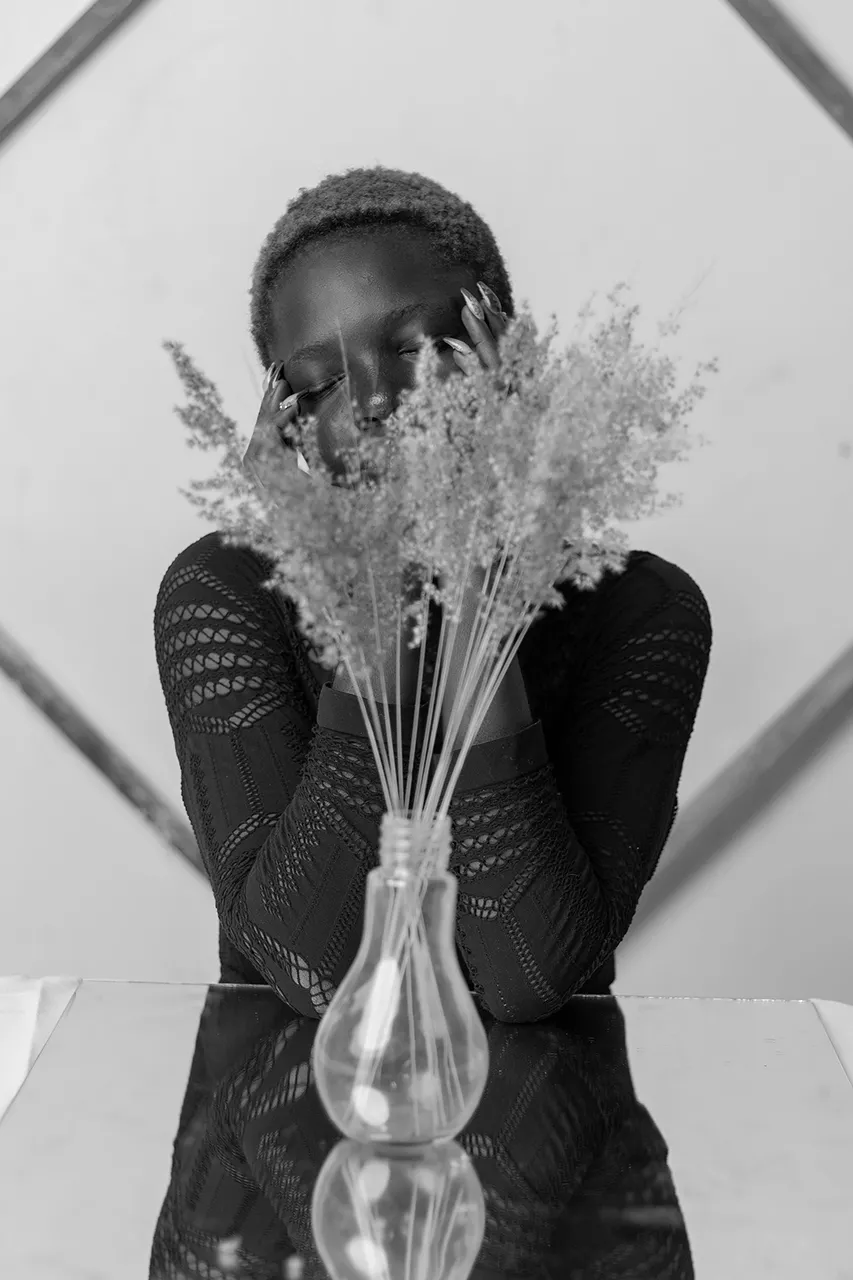
I have questioned the origins of this weight that I’ve been carrying far and long and wide. This weight that knows my mother’s shoulders, and her mother’s shoulders, and her mother’s mother’s shoulders. I come from a long line of women who have been carrying all this weight. And I have often fixed my tongue to say that it is solely lineal. But the more that I’ve thought about it, studied it, carried it, turned it inside out, I’ve recognized this is a weight embedded by a nation. The United States of America, and the Republic for which it stands — or rather, centuries of labor of Black women for which this country stands upon.
This weight I am carrying, that the women in my family have been carrying, did not start with us, nor will it end with us. This is the weight of Black women everywhere, from slavery to modern day. Black women who’ve been forced to be the balm, forced to be the strong ones, forced to be the structures on which everyone else stands while we’re crumbling underneath. Struggling to get by. Fighting for equity and justice and honor and care.
When I think about unresolved harm in the United States, Black women remain at the center of injury. And I think about how this is a continuous impairment that erodes Black women and the communities and ecosystems connected to us. An endless oppression where Black women are put in this place of merely surviving as opposed to being given the space to fully function. What should be our birthright has become something that we remain in an exhausted pursuit of.
Black women have been forced to live in survival mode. When I think about inheritance, all I can think about is inheriting this sense of needing to endure, even when the systems causing the harm could care less about whether or not I can withstand the pressures placed upon me.
I’ve witnessed all the women that I come from endure. I’ve seen them fight endlessly against systems and policies not designed with the wellbeing or safety of Black women in mind.
This country has never repaired the forced labor and suffering of the Black woman. Even though it extracts from us continuously.
While we have witnessed Black women resist the attempts to limit their existence, the harm imposed has not been fully rectified.
The afterlife of harm that has been imposed on Black women, I believe, travels first through our interior selves and families, before making its way into our communities and ecosystems. You see it in daughters assuming the roles of their mothers who operated from survival, and how that gets passed on from generation to generation. You see it in communities where the Black woman isn’t protected or respected, left to fend for hers all on her own. Black women continue to be put up against systems of harm — be it in her very home, in healthcare or economical settings, in the workforce and so on. Because we are expected to carry all this weight and endure it. To not ask for the load to be made lighter. To put our armor on and go to war with the world. Despite us begging for ease, for safety, for care. We are continuously forced to endure.
It’s hard to imagine what the full extent of repair would entail, but I believe that a meaningful way to begin restoration is for this country to acknowledge the harm that has been bestowed upon Black women for centuries and to start making movements towards ceasing any further harm to be repeated. That would require looking at the ugly truths of the past and also seeing how those occurrences have been carried into systems and policies that exist in the present day that continuously harm Black women and everything connected to them. Economic exploitation, the maternal health crisis and reproductive injustice, institutionalized racism, sexual violence. Sometimes it feels like far too much harm to name, but this country needs to start naming the harm anyway. This can look like listening to Black women who are advocating for better systems and policies and care, and not excluding us from the conversations or decision-making processes.
Holding the One Who Held Us
"What does it mean when the generation that held our family together suddenly needs someone else to hold them?"
For most of my life, my mother taught my sister and me that family was the main thing. She never framed it as a lesson. She lived it. Family meant showing up before being asked. It meant celebrating together, grieving together, and carrying one another through seasons that felt too heavy to bear alone. No accomplishment, disagreement, or distance was ever supposed to matter more than the people who shared your name and your story.
Last October, our family lost my father. While we were still learning how to live with that grief, another unexpected chapter unfolded. Seeking relief from years of chronic pain, my mother entered hospice care so she could better manage her pain. The narcotic medication she was prescribed triggered a severe manic episode related to her bipolar disorder. The woman who had always been our steady foundation suddenly needed others to become hers.
Watching someone you love move through a mental health crisis is heartbreaking. It can be confusing, exhausting, and isolating. There were days when my sister and I questioned whether we were saying the right things or making the right decisions. Healing did not come all at once. It came slowly, through consistency, patience, medical adjustments, and hope. Even now, she is gradually returning to herself.
As Black daughters, we often inherit more than family traditions. We inherit the responsibility of caring for one another through loss, illness, and hardship, sometimes with very little outside support. That responsibility is rooted in love, but it also reflects a reality that many Black families know well: when systems fall short, families become the ones who bridge the gaps. We become caregivers, advocates, organizers, and encouragers because there is often no one else to do it.
My mother spent decades teaching us that family was the main thing. I don't think she realized she was preparing us for this season of our lives. Today, my sister and I are simply loving her the way she first loved us. We remind her of her strength when she cannot see it herself. We celebrate each small step forward. We choose patience over frustration because that is what she modeled long before she needed it in return.
For me, repair has come to mean something different than restoration. Repair is not pretending that grief never happened or wishing away mental illness. Repair is choosing to remain present. It is refusing to let hardship separate us. It is carrying forward the values that have sustained our family across generations.
The greatest inheritance my mother could have given me was not money or possessions. It was the conviction that family is worth fighting for.
Today, that lesson lives in me, in my sister, and, I pray, one day in my children. That is how our family's story continues not because life has been free from harm, but because love has remained stronger than it.
One of the greatest losses was the opportunity for our family to grieve one profound loss before facing another. After my father died in October, I imagined that my mother, my sister, and I would lean on one another as we learned how to live without him. Instead, my mother's medication-induced manic episode changed the role each of us had to play. Rather than grieving as daughters, my sister and I quickly became caregivers, advocates, decision-makers, and emotional anchors.
That shift interrupted something important. We lost the ability to simply mourn. Grief became intertwined with responsibility. There were medical appointments to navigate, difficult conversations to have, and daily decisions that required patience and consistency, even while we were carrying our own heartbreak.
This experience also deepened my awareness of how many Black families shoulder caregiving responsibilities with limited support. We often become the first responders in our own homes, balancing work, children, finances, and emotional care while trying to navigate complex healthcare systems. Love compels us to do it, but love alone cannot erase the exhaustion or uncertainty that comes with it.
The effects continue to shape my life today. I have learned that healing is rarely linear and that recovery cannot be rushed. I have also become more intentional about checking in on my family, documenting our stories, and making time to be together. Losing my father reminded me that time is not promised, and nearly losing my mother's sense of stability reminded me that the people who have always cared for us may one day need us to care for them.
Even through these challenges, one thing has remained unchanged: the value my mother instilled in us that family is the main thing. That belief continues to guide every decision my sister and I make. It has become both our inheritance and our response to hardship. While we cannot undo our losses, we can ensure that the love, commitment, and responsibility that have always defined our family continue into the next generation.
As the United States approaches its 250th anniversary, I believe accountability begins with acknowledging that many of the burdens Black families carry today did not emerge in isolation. They have been shaped by generations of unequal access to quality healthcare, mental health services, economic opportunity, and systems that too often ask families to navigate crisis on their own.
My family's story taught me that healing requires more than good intentions. When my mother experienced a mental health crisis after seeking relief for chronic pain, my sister and I became her caregivers while still grieving the loss of our father. We did so willingly because that is what family means to us, but I also recognize that many Black families carry similar responsibilities with little support. Caregiving, advocacy, and crisis management often become invisible labor performed behind closed doors.
Meaningful repair requires building systems that honor the dignity of Black families before they reach moments of crisis. That means expanding access to culturally responsive mental healthcare, improving support for family caregivers, strengthening community-based services, and ensuring that people living with mental illness receive compassionate, coordinated care. It also means recognizing that healing is not only medical, it is relational. Families need time, resources, and support to care for one another without sacrificing their own well-being.
Repair also requires preserving the stories of those who came before us. Every family carries knowledge, values, and traditions that deserve to be remembered. When we create space for those stories to be shared, documented, and honored, we affirm that Black lives are not only defined by struggle but also by resilience, love, wisdom, and community.
As a Black woman, an educator, and a daughter, I have come to believe that repair is not only about correcting the past. It is about creating a future where Black families are supported, believed, and given the resources to thrive, not just survive. My hope is that the next generation inherits more than our resilience. I hope they inherit systems worthy of the love and strength our families have always carried.
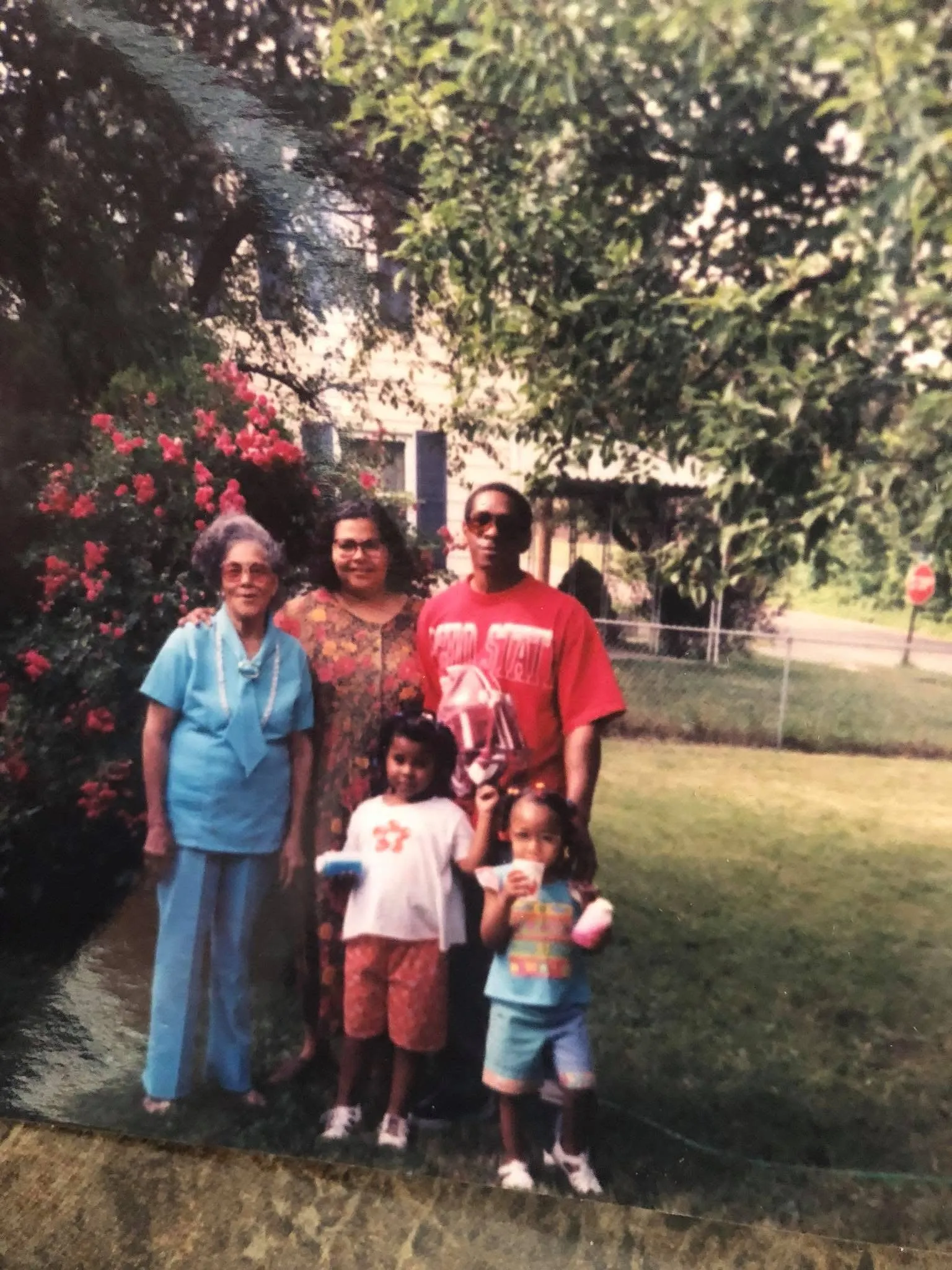
Holding the Edge: The Weight of Survival for Black Women
What if the rage of Black Women was the key to liberation? What if our anger was sacrosanct, meant to be worshipped, honored, and held in reverence? See, when we rage, we see beyond the fire. We see a light burning in the flame of our vision and we stretch it out into the universe.
We, in fact, build worlds.
Our expression leads to the excavation of lost artifacts, the things that we need to get back to. When we are hurt in love, we find the love we never had in ourselves. When our pain is weaponized against us, we create space and uplift the voices of others. When the system makes care inaccessible, we create our own systems of collective care. Where we are kept out, we enact our bodies as ladders and lift each other up. Where there is no repair when harm has been done, we create space for transformative justice. We do not dispose, disregard, or destroy one another. In our fury we see the future.
I believe that our rage is not only necessary, but holy. I believe that it is necessary for our freedom. Audre Lorde describes the predicament of Black womxn perfectly when she says "Survival is not theoretical when living on the edge of any structure. For a Black woman and a lesbian, survival becomes very real when one is conscious that their identity is on the edge."
What is the cost of holding the weight of the edge, the heaviness of this sacred rage, while birthing a new world?
The edge is not simply conceptual, but it is the fabric that texturalizes the lives of Black womxn everyday. We do this dance with life and death. A dance that the state calls beautiful, a dance that often leads to our deaths. This edge is not neutral, it is volatile. It is a void of white supremacy. It sits between our living and our survival, our thriving and our existing. It is the cavern that we continuously transmute ourselves beyond.
The weight of this dance, of this volatile structure sits heavy. It sits so heavily, and yet calls for our prevalence beyond it. We say “fuck it” to the edge all of the time. This thing that enrages us into action, into astral projecting into a more liberated future where such a cavern does not exist. A liberated space where we truly get to live.
It is because of Black Women’s particular predicament that I believe that we hold an unfathomable weight: living a liberated future in the collective, that is not overtly present in our everyday. Meaning, we have created our own present freedoms, and survived apocalypses, without knowing if the structured edge will ever soften for us to live.
The edge is sharp. The edge is violent. The edge says fall in. The edge says it will burn up our bridges. Black women say, I will go to hell, defeat the devil, climb out, build a bridge to heaven, and take all of my people with me.
How do you carry that? In a body that knows the edge so intimately. In a spirit that craves rest.
It’s because that rage I am speaking to is otherworldly, holy, and beyond imagination. Black women are asked to be god(s) in a godless world. I think both religious and religious folx can understand the notion I am getting at when I say that we are building the blueprint of a liberated future in a space of desecration. We hold it, because we know no one else well. We rage, we get tired, we rest, but it is in ourselves that we see that as righteous.
The weight of world-building should not solely be on Black women, but it often is. We are midwifing in a society that calls our rage ugly, aggressive, or ignored. We call in that space for ourselves, we hold each other in it. I want to live in a world without an edge. I feel that way when I am in space with other Black women, in community with other Black women, loved by other Black women, raging with other Black women, and building with other Black women.
The world pretends this weight is invisible, to profit, to gain, and to destroy us. We know that part of this perceived “invisibility” is just capitalism saying “more, more, more”... “die, die, die.” We carry this weight, and this rage in tandem. Meaning, our shit is not sold separately.
Our rage says, I’m going to live, I’m going to let it be heavy.. as heavy as heavy gets, and build a world with my sisters. One where we get to live, and not just survive. One that tells survival to jump off of the edge.
One that says…
Live, live, live.
The edge of survival, literally makes it virtually impossible for Black Womxn to truly live, and yet, we find ways to do so. I think this essay speaks to that notion, that the denial of our livelihood, that the criminalization and erasure of our rage is a part of that edge. In the midst of that, we still create our own liberated futures. I don't think the society that we live in, as it stands right now, cares about a future with Black womxn being whole in it, yet alone, existing in it. In fact, it caters to our destruction. We create our own systems of repair. I believe that it is our sacred rage at this reality, at this precariousness, that drives us to world building. However, this comes with a tremendous weight, that in this essay I attempt to name, lift up, and contend with.
America needs to get off of the edge. It needs to erase the edge. It needs to name the edge. It needs to theoretically jump off of the edge. What I mean by that, is that America has co-opted and propped up this edge for Black Womxn. It has given it some serious architecture and death-making abilities. The edge is not theoretical. It is sharp and it aims to devour. This country has to soften the edge, to excavate the edge, to remove the edge. It has to disappear the age, in the same rigor that it aims to disappear us. It would have to create and imbed the systems we have created through our rage.
Holding the Edge: The Weight of Survival for Black Women
What if the rage of Black Women was the key to liberation? What if our anger was sacrosanct, meant to be worshipped, honored, and held in reverence? See, when we rage, we see beyond the fire. We see a light burning in the flame of our vision and we stretch it out into the universe.
We, in fact, build worlds.
Our expression leads to the excavation of lost artifacts, the things that we need to get back to. When we are hurt in love, we find the love we never had in ourselves. When our pain is weaponized against us, we create space and uplift the voices of others. When the system makes care inaccessible, we create our own systems of collective care. Where we are kept out, we enact our bodies as ladders and lift each other up. Where there is no repair when harm has been done, we create space for transformative justice. We do not dispose, disregard, or destroy one another. In our fury we see the future.
I believe that our rage is not only necessary, but holy. I believe that it is necessary for our freedom. Audre Lorde describes the predicament of Black womxn perfectly when she says "Survival is not theoretical when living on the edge of any structure. For a Black woman and a lesbian, survival becomes very real when one is conscious that their identity is on the edge."
What is the cost of holding the weight of the edge, the heaviness of this sacred rage, while birthing a new world?
The edge is not simply conceptual, but it is the fabric that texturalizes the lives of Black womxn everyday. We do this dance with life and death. A dance that the state calls beautiful, a dance that often leads to our deaths. This edge is not neutral, it is volatile. It is a void of white supremacy. It sits between our living and our survival, our thriving and our existing. It is the cavern that we continuously transmute ourselves beyond.
The weight of this dance, of this volatile structure sits heavy. It sits so heavily, and yet calls for our prevalence beyond it. We say “fuck it” to the edge all of the time. This thing that enrages us into action, into astral projecting into a more liberated future where such a cavern does not exist. A liberated space where we truly get to live.
It is because of Black Women’s particular predicament that I believe that we hold an unfathomable weight: living a liberated future in the collective, that is not overtly present in our everyday. Meaning, we have created our own present freedoms, and survived apocalypses, without knowing if the structured edge will ever soften for us to live.
The edge is sharp. The edge is violent. The edge says fall in. The edge says it will burn up our bridges. Black women say, I will go to hell, defeat the devil, climb out, build a bridge to heaven, and take all of my people with me.
How do you carry that? In a body that knows the edge so intimately. In a spirit that craves rest.
It’s because that rage I am speaking to is otherworldly, holy, and beyond imagination. Black women are asked to be god(s) in a godless world. I think both religious and religious folx can understand the notion I am getting at when I say that we are building the blueprint of a liberated future in a space of desecration. We hold it, because we know no one else well. We rage, we get tired, we rest, but it is in ourselves that we see that as righteous.
The weight of world-building should not solely be on Black women, but it often is. We are midwifing in a society that calls our rage ugly, aggressive, or ignored. We call in that space for ourselves, we hold each other in it. I want to live in a world without an edge. I feel that way when I am in space with other Black women, in community with other Black women, loved by other Black women, raging with other Black women, and building with other Black women.
The world pretends this weight is invisible, to profit, to gain, and to destroy us. We know that part of this perceived “invisibility” is just capitalism saying “more, more, more”... “die, die, die.” We carry this weight, and this rage in tandem. Meaning, our shit is not sold separately.
Our rage says, I’m going to live, I’m going to let it be heavy.. as heavy as heavy gets, and build a world with my sisters. One where we get to live, and not just survive. One that tells survival to jump off of the edge.
One that says…
Live, live, live.
I think about how frequently I am learning through songs. Whether it is the ABCs, a breakup anthem (via Beyonce of course), or further engagement in a current social justice narrative (e.g., Kendrick Lamar's “We Gon’ Be Alright”), I think, stop, and reflect on how my
engagement in said topic is often situated in the opportunity to fuse my understanding of how learning through song can be used to interrogate my world at the given moment. This powerful link responds to how music historically has transformed and liberated communities of color.
Evans-Winters (2019) engages in qualitative inquiry of Black women’s knowledges with a recognition of the cultural and spiritual beliefs at the core of the expression of their marginalization and suppression (p.1). Simply, my positionality responds to a natural/essence and phenomena of Black women’s sensemaking. It starts with my knowledge of family. My grandparents from rural Kentucky moved to the “big city” of Lexington to raise their five (5) children and did everything they could to give them a better life. I can recount stories of my Grandaddy Bertie saying he wanted me to get more than a seventh-grade education like he had. My Grandma shared similar sentiments. She recalled often to me and my cousins how one accomplishment she had in life was making sure all five (5) of her kids successfully received their high school diplomas. My mother, the only one of her five siblings, not only achieved her high school diploma but went on to gather her Bachelor of Arts degree from a Historically Black College University (HBCU). She set a precedent and standard for the value of education for me. For my beautiful Black family, education as liberation and freedom was the impetus for my joy.
My positionality responds to multiple layers of my identity. As I experience the world from a Black heterosexual cisgender able-bodied woman’s perspective, I am conscious of my interpretations of the world from both privileged and oppressed standpoints. An understanding
of my joy, specifically Black joy, is rooted in where my parents first met and discovered the joy of parenthood.
My parents will tell you that they felt a mixture of fun frolicking joy,
and fear starting the journey to parenthood. My mother was adamant about not wearing maternity clothes, and if she did, she would not allow them to be photographed. My father was consumed with maintaining his cool. “We were kids." They were unapologetically them. They stuck to the moment, opened their minds to the realities of something new (me—the baby), and they did not rush to figure out all that was ahead.
Both first-generation college students attended the historically Black college of Kentucky State University, this is where my parents met and found their voice. A university saturated with Black joy is where they grew to know one another and create a person (me), that would know that joy in the next generation. While narratives of Black women are unfortunately still told in dominant White educated elite spaces, my parents chartered a new way to tell these stories by choosing to
attend this school, take a risk in knowing one another, and teach a new generation about the beauty in Blackness and womanness. My positionality is rooted in this beginning. The expressions of change, resistance, and the uniqueness of my joy aid in the choice to reflect
more about joy.
My footsteps follow not only in the grief of my ancestors but also in the ways that they imagined something new. My goal in this research inquiry, inspired by my positionality and subjectivities is to interrogate and imagine spaces that reclaim and order “genealogies of resilience and existing” (Butler, 2018), in the ways that I have always known.
Education assisted, but led to a disruption of joy, financial realities, emotional habits and a keen awareness of institutional mistrust.
I 100% believe in reparations. I also believe in amplifying white mediocrity.
I think about how frequently I am learning through songs. Whether it is the ABCs, a breakup anthem (via Beyonce of course), or further engagement in a current social justice narrative (e.g., Kendrick Lamar's “We Gon’ Be Alright”), I think, stop, and reflect on how my
engagement in said topic is often situated in the opportunity to fuse my understanding of how learning through song can be used to interrogate my world at the given moment. This powerful link responds to how music historically has transformed and liberated communities of color.
Evans-Winters (2019) engages in qualitative inquiry of Black women’s knowledges with a recognition of the cultural and spiritual beliefs at the core of the expression of their marginalization and suppression (p.1). Simply, my positionality responds to a natural/essence and phenomena of Black women’s sensemaking. It starts with my knowledge of family. My grandparents from rural Kentucky moved to the “big city” of Lexington to raise their five (5) children and did everything they could to give them a better life. I can recount stories of my Grandaddy Bertie saying he wanted me to get more than a seventh-grade education like he had. My Grandma shared similar sentiments. She recalled often to me and my cousins how one accomplishment she had in life was making sure all five (5) of her kids successfully received their high school diplomas. My mother, the only one of her five siblings, not only achieved her high school diploma but went on to gather her Bachelor of Arts degree from a Historically Black College University (HBCU). She set a precedent and standard for the value of education for me. For my beautiful Black family, education as liberation and freedom was the impetus for my joy.
My positionality responds to multiple layers of my identity. As I experience the world from a Black heterosexual cisgender able-bodied woman’s perspective, I am conscious of my interpretations of the world from both privileged and oppressed standpoints. An understanding
of my joy, specifically Black joy, is rooted in where my parents first met and discovered the joy of parenthood.
My parents will tell you that they felt a mixture of fun frolicking joy,
and fear starting the journey to parenthood. My mother was adamant about not wearing maternity clothes, and if she did, she would not allow them to be photographed. My father was consumed with maintaining his cool. “We were kids." They were unapologetically them. They stuck to the moment, opened their minds to the realities of something new (me—the baby), and they did not rush to figure out all that was ahead.
Both first-generation college students attended the historically Black college of Kentucky State University, this is where my parents met and found their voice. A university saturated with Black joy is where they grew to know one another and create a person (me), that would know that joy in the next generation. While narratives of Black women are unfortunately still told in dominant White educated elite spaces, my parents chartered a new way to tell these stories by choosing to
attend this school, take a risk in knowing one another, and teach a new generation about the beauty in Blackness and womanness. My positionality is rooted in this beginning. The expressions of change, resistance, and the uniqueness of my joy aid in the choice to reflect
more about joy.
My footsteps follow not only in the grief of my ancestors but also in the ways that they imagined something new. My goal in this research inquiry, inspired by my positionality and subjectivities is to interrogate and imagine spaces that reclaim and order “genealogies of resilience and existing” (Butler, 2018), in the ways that I have always known.
I've thought about this topic my entire life. It started with the murder-suicide of my grandparents. I was 8. They were my image of marriage. They started getting a divorce. I didn't understand why. A few weeks later, my Muslim grandfather murders my Christian grandmother in front of the her church six months before 9-11. My family is a afraid of anything Islam now, despite multiple children in my family (including me) having Muslim names. Some of the folks with Muslim names have taken to giving their kids really anglo sounding names. Shareef's kids are Skye and Jace. Granted their last name is still Abdul-Haqq, but as one of the kids that had the Muslim firstname Anglo last name combo, I always thought that the full arabic name was beautiful. I know what he cost is. I'm sure that they just wanted to take one thing off the kids' plate. There's enough that we face as Black people, add that "ghetto" "Black Nationalist" thing to it and America becomes and extremely exhausting place. In fact, I watched as my mother, who has an extremely Anglo name (her first name it means War-like. her middle name means reborn) and made sure that my brother and I took great pride in our names (my name roughly translates to Mascline Light and Feminine Wisdom, since Arabic is a gendered language), face every challenge imaginable. Includeing losing my grandparents house because she just didn't know the rules of property. She also didn't think she could slow down enough to try to learn. I also think that the land has become the site of so much trauma for us, some of us don't actually want to hold on to it. We want to find somewhere new. That's why I think space appeals to some Black people. It's why it appealed to me. I don't want to colonize. I want the awe. I want the wonder. I want to be immersed in the reminder of my smallness. White people (like some of us) want to run away from the harm they caused. They don't want to face the damage they've caused so they figured they can just run away. I've been that person in my interpersonal relationships. When you've harmed and been harmed in a space it's easier to "quit while you're behind" or "cut your loses" than do the work to clean it up and create something new. I can admit that I tend to do it interpersonal relationships. Some times the lift seems too big and I'm not ready to face what needs tobe faced and I'm afraid of who I'm going to have to become to face it. That's often the scariest part, "Who will I become? Will I still know myself if I face the ugly?"
I intellectualize love instead of being in love. I'm more concerned about how love shows up in the public sphere. I don't know how to hold it in private. It isn't just a me thing. It is a familial and communal thing. I see it in the women that I date. I see it in the men that I'm in community with. I hear it in the way the children speak. We know what has been done to us. We also bring that pain home and put it on the people closest to us. That's what happened to my grandparents, and a lot of my family members are afraid to face it. I see it on the socials where a lot of us are realizing, "Our grandmoms had to make some TERRIBLE choices, and our grandpops where terrible guys!" They might have been GREAT guys to us, but they were tyrants to the people closest to us. I'm also curious about what that says about us and our ability to be whole? Do we try to flatten ourselves? Are we afraid of our grief, our anger, our joy, our love, our rage, our shame, our softness, our voice? What does that do to us? I have more questions than answers. I know that I'm interested living much differently than the generations before me. I know that this isn't sustainable.
I think rest. Rest. Rest. Rest. Rest. Rest. We need some time to spend with ourselves. We need time to recover stories. We need a lot of connecting to each other. Honestly, I'd be pro-intentional-segriation. Not the same way that we were systemically deprived of resources so we felt we had to integrate to get what we need. I'd be down for legitimate seperate but equal. We can have our businesses. We can have our homes and build wealth. Give us our farmland. Do the valuation on 40-acres and a mule. Figure out what that ammounts to then get to giving the same tax breaks, subsidies, land grants, and everyting elese that you gave to the white folk. Actually, maybe not even that, because Ingenous people's land. As a spooky shorty who legit found an eagle feather like the ones Kevin Gates be wearing (mine is bigger...yes...that was THAT kind of joke, but also a fact) on Indigenous land and the Chief let me keep it said, "That means your ancestors are watching out for you." I was doing a beach clean up. I was loving on the land. I think that there needs to be an option to go back to Africa if you choose (Lyberia for sure) or join a Native Corporation (Alaska Natives)/Reservation and rebuild/implement Native ways of knowing and being and relating to the land.
I've thought about this topic my entire life. It started with the murder-suicide of my grandparents. I was 8. They were my image of marriage. They started getting a divorce. I didn't understand why. A few weeks later, my Muslim grandfather murders my Christian grandmother in front of the her church six months before 9-11. My family is a afraid of anything Islam now, despite multiple children in my family (including me) having Muslim names. Some of the folks with Muslim names have taken to giving their kids really anglo sounding names. Shareef's kids are Skye and Jace. Granted their last name is still Abdul-Haqq, but as one of the kids that had the Muslim firstname Anglo last name combo, I always thought that the full arabic name was beautiful. I know what he cost is. I'm sure that they just wanted to take one thing off the kids' plate. There's enough that we face as Black people, add that "ghetto" "Black Nationalist" thing to it and America becomes and extremely exhausting place. In fact, I watched as my mother, who has an extremely Anglo name (her first name it means War-like. her middle name means reborn) and made sure that my brother and I took great pride in our names (my name roughly translates to Mascline Light and Feminine Wisdom, since Arabic is a gendered language), face every challenge imaginable. Includeing losing my grandparents house because she just didn't know the rules of property. She also didn't think she could slow down enough to try to learn. I also think that the land has become the site of so much trauma for us, some of us don't actually want to hold on to it. We want to find somewhere new. That's why I think space appeals to some Black people. It's why it appealed to me. I don't want to colonize. I want the awe. I want the wonder. I want to be immersed in the reminder of my smallness. White people (like some of us) want to run away from the harm they caused. They don't want to face the damage they've caused so they figured they can just run away. I've been that person in my interpersonal relationships. When you've harmed and been harmed in a space it's easier to "quit while you're behind" or "cut your loses" than do the work to clean it up and create something new. I can admit that I tend to do it interpersonal relationships. Some times the lift seems too big and I'm not ready to face what needs tobe faced and I'm afraid of who I'm going to have to become to face it. That's often the scariest part, "Who will I become? Will I still know myself if I face the ugly?"
For much of my life, I understood faith as a family tradition. Only after my father passed away in January 2026 did I begin to understand it differently as an inheritance shaped by generations of Black Americans who learned to survive in a country that too often denied them safety, dignity, and opportunity.
Growing up in Omaha, Nebraska, every Sunday my mother and I drove to Robinson Memorial Church of God in Christ in North Omaha, one of the city's historically Black communities. As a child, I did not understand why people referred to our destination as "going down North," nor did I recognize how segregation, redlining, and disinvestment had shaped the neighborhood. I simply knew that church was one of the few places where I was surrounded by people who looked like me. It was where I learned belonging before I understood history.
My education about survival happened just as much at home as it did in church. Before school each morning, my mother prayed over me, anointed my head with oil, and reminded me that God had a purpose for my life. Prayer was not reserved for moments of crisis. It was woven into the rhythm of our everyday lives. Even now, as an adult, she begins many mornings by sending me a text message with scripture and a prayer before my workday begins.
Looking back, I no longer see those rituals as simply expressions of faith. I see them as practices of protection.
Someone in my family decided that Black children should leave home covered in prayer because the world outside could not always be trusted to protect them. Someone believed that reminding a child of her worth before she entered school mattered because they understood that institutions might not always affirm it. Those practices were passed from one generation to the next, not because justice had been achieved, but because it had not.
When conversations about reparations focus only on financial compensation or legislation, they often overlook the emotional and cultural inheritance created by generations of unresolved harm. My family inherited faith, resilience, and a commitment to education because earlier generations had to create ways of surviving systems that frequently excluded or devalued them. Those inheritances helped make my own educational journey possible, eventually leading me to become an educational leader and researcher committed to creating more equitable schools.
At the same time, I recognize that resilience should not be mistaken for repair. My mother, an elementary principal, suffered a stroke during her career. Although I cannot say her work alone caused it, her experience reminds me that Black women have too often carried extraordinary responsibilities without the institutional support needed to sustain them. I have witnessed similar patterns throughout education, where Black women are expected to lead, nurture, advocate, and persist while often neglecting their own well-being.
For me, repair is not only about acknowledging past injustice. It is about creating conditions where future generations no longer have to inherit survival as their primary legacy. I hope Black girls inherit rest alongside resilience, opportunity alongside responsibility, and institutions that recognize their brilliance without requiring them to continually prove their humanity.
That, to me, is what repair begins to look like.
What was lost was the freedom to simply be children, families, learners, and leaders without first having to prepare for harm.
In my family, faith became a source of strength, but it also reveals what was denied. Black families should not have had to rely on prayer as protection from schools, neighborhoods, workplaces, and institutions that often failed to value them fully. The rituals I inherited being prayed over before school, being reminded of my worth before entering public spaces, being taught that my gift would make room for me were beautiful, but they were also responses to a world where belonging was not guaranteed.
The effects continue to show up in how Black women are expected to carry more than their share. In education especially, I have seen Black women lead, nurture, advocate, and repair systems while receiving limited support for their own well-being. Resilience becomes expected. Excellence becomes rewarded with more labor. Rest becomes something we must justify.
In my own family, I think about my mother, a former principal, who suffered both medically and physically during her career. I cannot claim her work alone caused it, but her experience reminds me that the body often carries what institutions refuse to acknowledge. The afterlife of harm shows up in stress, silence, overwork, and the belief that strength means continuing no matter the cost.
What was interrupted was ease. What was denied was safety. What was made more difficult was the ability to thrive without constantly proving worth.
Today, I carry both gratitude and grief for these inheritances. I am grateful for the faith that sustained my family, but I grieve that survival had to become such a central lesson. Repair would mean creating a world where Black girls inherit more than endurance where they inherit rest, joy, opportunity, and institutions that recognize their humanity from the beginning.
As the United States approaches its 250th anniversary, I believe its first responsibility is to tell the truth not only about slavery, segregation, and discrimination, but also about the ways those histories continue to shape the lives of Black communities today. Accountability begins with acknowledging that the effects of historical harm did not end when laws changed. They continue to appear in schools, neighborhoods, health outcomes, wealth disparities, and the emotional burdens families carry across generations.
Meaningful repair requires more than remembrance. It requires transformation.
For me, repair includes investing in the institutions that have historically underserved Black communities, particularly public education. Schools should be places where Black children encounter histories that affirm their humanity, teachers who reflect their communities, and learning environments that nurture their brilliance rather than require them to prove it. Repair also means supporting the educators—especially Black women who have long carried the work of holding schools and communities together, often at great personal cost.
Repair also asks us to honor forms of knowledge that have too often been overlooked. The prayers whispered over children before school, the family sayings passed from one generation to the next, the churches that became places of refuge, and the stories shared around kitchen tables are not simply private memories. They are evidence of how Black families responded to unresolved harm when institutions failed to protect them. Preserving those stories is itself an act of accountability because it recognizes that history lives not only in official records but also in the lives of ordinary people.
Ultimately, I do not believe repair asks us to erase the past. It asks us to confront it honestly and create different possibilities for the future. I hope the next generation of Black children inherits more than resilience. I hope they inherit equitable schools, healthy communities, economic opportunity, and the freedom to dream without survival being their first lesson. If my ancestors carried survival and my parents carried opportunity, then I hope my generation helps build a country where our children inherit healing.
For much of my life, I understood faith as a family tradition. Only after my father passed away in January 2026 did I begin to understand it differently as an inheritance shaped by generations of Black Americans who learned to survive in a country that too often denied them safety, dignity, and opportunity.
Growing up in Omaha, Nebraska, every Sunday my mother and I drove to Robinson Memorial Church of God in Christ in North Omaha, one of the city's historically Black communities. As a child, I did not understand why people referred to our destination as "going down North," nor did I recognize how segregation, redlining, and disinvestment had shaped the neighborhood. I simply knew that church was one of the few places where I was surrounded by people who looked like me. It was where I learned belonging before I understood history.
My education about survival happened just as much at home as it did in church. Before school each morning, my mother prayed over me, anointed my head with oil, and reminded me that God had a purpose for my life. Prayer was not reserved for moments of crisis. It was woven into the rhythm of our everyday lives. Even now, as an adult, she begins many mornings by sending me a text message with scripture and a prayer before my workday begins.
Looking back, I no longer see those rituals as simply expressions of faith. I see them as practices of protection.
Someone in my family decided that Black children should leave home covered in prayer because the world outside could not always be trusted to protect them. Someone believed that reminding a child of her worth before she entered school mattered because they understood that institutions might not always affirm it. Those practices were passed from one generation to the next, not because justice had been achieved, but because it had not.
When conversations about reparations focus only on financial compensation or legislation, they often overlook the emotional and cultural inheritance created by generations of unresolved harm. My family inherited faith, resilience, and a commitment to education because earlier generations had to create ways of surviving systems that frequently excluded or devalued them. Those inheritances helped make my own educational journey possible, eventually leading me to become an educational leader and researcher committed to creating more equitable schools.
At the same time, I recognize that resilience should not be mistaken for repair. My mother, an elementary principal, suffered a stroke during her career. Although I cannot say her work alone caused it, her experience reminds me that Black women have too often carried extraordinary responsibilities without the institutional support needed to sustain them. I have witnessed similar patterns throughout education, where Black women are expected to lead, nurture, advocate, and persist while often neglecting their own well-being.
For me, repair is not only about acknowledging past injustice. It is about creating conditions where future generations no longer have to inherit survival as their primary legacy. I hope Black girls inherit rest alongside resilience, opportunity alongside responsibility, and institutions that recognize their brilliance without requiring them to continually prove their humanity.
That, to me, is what repair begins to look like.
girl with the ballies in her hair
when i was younger i played soccer
a little black and dominican girl laying on the grass and watching time pass
isolated from her other teammates because they didn’t have room in their white space
i hear them giggling and i want to laugh
but every time i try to interject
i receive a cold stare
a glare
i guess they don’t want to communicate with the girl who has ballies in her hair?
i was on that team for 3 and half years
but i left eventually
after a while you get tired when no one congratulates you for winning a game or even bothers to remember your name
what happens to a dream deferred?
is it stuck in your adolescence ? remember when your teacher would ask that infamous question, “what do you wanna be when you grow up?” they said
but you’re afraid to walk back home
hoping you don’t end up dead
is it in high school and stuck in the back of your notebook with drawings while your teacher is calling your name?
wondering what’s going on in your brain
is it with you while your laying down and you look up at the ceiling? wondering where the hell your life is going?
everyone’s dream is different and you’ll get it when you least except it
your dream may just sag like a heavy load
maybe it might even explode?
When I was younger I wanted so badly to feel accepted in some predominantly white space I was involved in. I was the only Black girl on an all white soccer team for almost three years. I just wanted to be active and make friends but they didn’t have room for me in their lives. I was always disheartened because, “did I do something wrong?”. I just felt so outside of my body and I wanted to change myself in order to be looked at as an equal. My family always instilled in me to love my Blackness and uniqueness but I the isolation was too much to bare especially at nine years old. When I do catch myself in those majority white spaces I move very differently with more confidence but in the back of my head I remember the loneliness I felt when running drills and being at away games.
This country needs to acknowledge the injustice and suffering Black individuals have endured. This can be through making sure DEI is not taken away, keeping Black history in school curriculum, giving reparations to ancestors of enslaved individuals, funding HBCUs, and giving impoverished communities more resources.
girl with the ballies in her hair
when i was younger i played soccer
a little black and dominican girl laying on the grass and watching time pass
isolated from her other teammates because they didn’t have room in their white space
i hear them giggling and i want to laugh
but every time i try to interject
i receive a cold stare
a glare
i guess they don’t want to communicate with the girl who has ballies in her hair?
i was on that team for 3 and half years
but i left eventually
after a while you get tired when no one congratulates you for winning a game or even bothers to remember your name
what happens to a dream deferred?
is it stuck in your adolescence ? remember when your teacher would ask that infamous question, “what do you wanna be when you grow up?” they said
but you’re afraid to walk back home
hoping you don’t end up dead
is it in high school and stuck in the back of your notebook with drawings while your teacher is calling your name?
wondering what’s going on in your brain
is it with you while your laying down and you look up at the ceiling? wondering where the hell your life is going?
everyone’s dream is different and you’ll get it when you least except it
your dream may just sag like a heavy load
maybe it might even explode?
When I was a little girl, my school gave every student a small cardboard folder with round slots pressed into it, each one sized for a coin. Quarters in one row, dimes in another, nickels in the last. The idea was simple and, I believed then, sacred. You filled the slots. You watched the booklet grow heavy in your hands. And when it was full, you carried it to the bank, where someone would count it, honor it, and teach you what money was actually for.
I filled mine with a kind of devotion. Every coin that came into my hands, I pressed into a slot instead of spending it. I remember the particular satisfaction of a booklet nearly done, how close it felt to becoming something official. This was not simply about saving money. It was about earning entry into a world of adults who understood banks, interest, and the mechanics of financial life. I was going to walk in with my full booklet and be taken seriously.
The bank never came back to my neighborhood.
I do not remember an announcement. I do not remember anyone explaining it to a room full of children. The program that had promised to teach us simply stopped showing up. The booklets stayed full. The lesson evaporated. Nobody told me the invitation had been withdrawn, because nobody thought a withdrawal like that required an explanation to the children on the receiving end of it.
What I understood, in the way a child understands things without language for them yet, was that the door I had been preparing to walk through had quietly closed, and closed only in my neighborhood. I did not yet know the word for a system that extends infrastructure to some communities and lets it dissolve in others. I only knew that my full booklet meant less than I had believed it would, and that the meaning had been taken from it by people I never met, for reasons no one explained.
I have spent decades since then working my way out from underneath a poverty mentality that has nothing to do with how much money I have made and everything to do with what I was taught, early and wordlessly, about whether financial understanding was mine to have. That coin booklet was never really about quarters. It was about who gets shown the mechanics of money as a birthright, and who is left holding a full container with nowhere to take it.
I am still doing that work. I imagine I will be doing it for a long time. But I have learned to call it what it was. Not a personal failing. A door that was built, then removed, before a child ever got to walk through it.
What was denied was not the coins themselves. It was the invitation to understand money as something a person like me was allowed to master. That coin booklet program was, in effect, a small early lesson in financial literacy, and it disappeared from my neighborhood without explanation before it ever completed its purpose. What was interrupted was the natural, unremarkable process by which a child learns that banks are safe, that saving has a destination, and that financial systems exist to serve her too.
The effects have outlasted the memory itself. For years I carried what I now recognize as a poverty mentality, not defined by lack of income but by a persistent internal bracing, an assumption that financial security could disappear as suddenly and inexplicably as that program did. I have had to teach myself, as an adult with real earning power, that money is something I am permitted to hold onto,
Fund financial literacy, and fund it the way infrastructure is funded: consistently, without depending on whether a neighborhood is judged worth the continued investment. What happened to me as a child was not a single denied opportunity. It was evidence of a pattern in which financial education is treated as optional charity in Black neighborhoods and standard provision everywhere else, quietly withdrawn the moment it becomes inconvenient or underfunded.
Meaningful repair would mean the country admitting that access to financial literacy has never been distributed evenly, and that the absence of it in certain communities was not an oversight but a predictable outcome of where resources were allowed to reach. It would mean building financial education into the fabric of under-resourced schools and communities permanently, not as a pilot program that can vanish without anyone accounting for the children left holding full booklets and no bank to walk them into.
Repair would also mean funding the professionals and institutions already doing this work in Black communities now, rather than starting over with programs designed elsewhere and imposed without input from the people who understand exactly what was taken. It would mean protecting these commitments from the kind of budget cycles that let a program simply stop showing up, with no one required to say why.
What this country should remember is that harm does not always arrive as violence. Sometimes it arrives as an absence so quiet a child cannot even name what disappeared, only that she was left standing there, holding something that was supposed to mean more than it turned out to mean.
When I was a little girl, my school gave every student a small cardboard folder with round slots pressed into it, each one sized for a coin. Quarters in one row, dimes in another, nickels in the last. The idea was simple and, I believed then, sacred. You filled the slots. You watched the booklet grow heavy in your hands. And when it was full, you carried it to the bank, where someone would count it, honor it, and teach you what money was actually for.
I filled mine with a kind of devotion. Every coin that came into my hands, I pressed into a slot instead of spending it. I remember the particular satisfaction of a booklet nearly done, how close it felt to becoming something official. This was not simply about saving money. It was about earning entry into a world of adults who understood banks, interest, and the mechanics of financial life. I was going to walk in with my full booklet and be taken seriously.
The bank never came back to my neighborhood.
I do not remember an announcement. I do not remember anyone explaining it to a room full of children. The program that had promised to teach us simply stopped showing up. The booklets stayed full. The lesson evaporated. Nobody told me the invitation had been withdrawn, because nobody thought a withdrawal like that required an explanation to the children on the receiving end of it.
What I understood, in the way a child understands things without language for them yet, was that the door I had been preparing to walk through had quietly closed, and closed only in my neighborhood. I did not yet know the word for a system that extends infrastructure to some communities and lets it dissolve in others. I only knew that my full booklet meant less than I had believed it would, and that the meaning had been taken from it by people I never met, for reasons no one explained.
I have spent decades since then working my way out from underneath a poverty mentality that has nothing to do with how much money I have made and everything to do with what I was taught, early and wordlessly, about whether financial understanding was mine to have. That coin booklet was never really about quarters. It was about who gets shown the mechanics of money as a birthright, and who is left holding a full container with nowhere to take it.
I am still doing that work. I imagine I will be doing it for a long time. But I have learned to call it what it was. Not a personal failing. A door that was built, then removed, before a child ever got to walk through it.
The Inherited Weight of Unresolved Harm
In the United States, conversations around accountability and repair often focus on institutional policies, yet the deepest, most enduring landscape of unresolved harm is frequently found within the home. Intergenerational trauma operates like an unwritten law, passed down through families and communities until someone consciously decides to break the chain.
Growing up in an environment shaped by abuse means learning how to survive long before ever learning how to feel safe. As a child, you are often too young to have the words for what is happening, but old enough to inherently feel that something is deeply wrong. In these spaces, your voice does not feel like your own, and you quickly internalize the lesson that staying quiet is the only way to keep things from getting worse. You learn to navigate the stillness of those moments by leaving your body without ever leaving the room, making yourself small, quiet, and masterfully disappearing in plain sight.
This kind of survival does not leave a person unchanged. It follows you into adulthood, settling deeply into your body, your decisions, and your very sense of self.
It forces you to carry a heavy, invisible responsibility that was never yours to hold. You adapt by becoming exactly who you need to be to keep the peace: strong, hyper-vigilant, and responsible. You learn to read rooms and anticipate energy just to maintain a fragile sense of control. Tragically, society often praises this hyper-vigilance as "strength" or "endurance," when what you actually need is care, safety, and protection.
The Millennial Mandate: Accountability as a Living Practice
True accountability requires looking directly at these patterns and acknowledging that survival is heavy. For generations, family abuse and trauma have been allowed to cycle continuously because the coping mechanisms silence, dissociation, and performative strength were passed down as survival tools.
As Millennials, however, my friends and I are approaching this unresolved harm with a collective determination to execute real repair. We are realizing that we no longer have to function without ever feeling grounded. We are actively choosing to look at the patterns we once thought were permanent and interrupt them.
For us, generational accountability means declaring: it ends with me. Stopping the Cycle: We refuse to pass the burden of our unhealed wounds onto our children. We are doing the heavy lifting of unlearning so that our kids never have to experience the environments that forced us to disappear.
Redefining Strength: We are transitioning away from a version of ourselves shaped entirely by what we endured, and stepping into a version shaped entirely by what we choose.
Demanding Real Care: We are learning what real care looks like, the kind that allows our children to take up space without needing to earn it, and holds them without expecting anything in return.
Reclaiming the Story and Finding Grounding
Repair is rarely linear; it is layered, messy, and requires revisiting the parts of ourselves we once tried to silence. For many of us, this healing journey was catalyzed by community, by mentors and chosen spaces that offered consistency, saw us clearly, and gave us room to understand ourselves without trying to "fix" us right away. They offered unconditional support, gently reminding us that we did not have to carry the weight of the world entirely alone.
Ultimately, this journey of repair has evolved from a personal battle into a profound spiritual awakening. In reclaiming my story piece by piece, I have come to realize that I was never as isolated as I felt. Looking back with more softness and understanding, I can see what I couldn't see when I was in the depths of survival: every time I thought I was holding myself together, it was Allah holding me.
“In every breath I steadied.
In every moment I endured.
In every step forward I didn’t think I had the strength to take…
Allah was there.”
By actively choosing how to move forward, we are transforming our lived experiences from a history of unresolved harm into a legacy of active, living repair. We are ensuring that while we may have been alone in aspects of our survival, our children will never be alone in their becoming.
Reclaiming the Blueprint: From Isolated Navigator to Community Learning
When you are denied a "regular childhood," you aren't just forced to grow up emotionally—you become a structural translator. You have to navigate complex, often hostile bureaucratic systems for the first time alone, and then turn around to teach your parents, elders, and community how to survive within them.
This is the heavy reality of the First-Generation Institutional Navigator. However, by reframing this isolated survival into a Community Learning Tool, we transform individual exhaustion into a blueprint for collective power.
The Systems We Were Forced to Decode
When systems are not built for us, the work of deciphering them usually falls on the youngest generation. In our community learning ecosystem, we map these exact landscapes:
Financial Institutions: Navigating banking, credit, and loans without generational wealth, then teaching our families that financial literacy is a tool for stability.
Maternal Health & Hospitals: Learning medical self-advocacy in clinical spaces that frequently dismiss marginalized bodies, and sharing how to demand dignity.
Housing & Landmarks: Facing gentrification, redlining, and tenant rights, while educating neighbors on how to protect local history and land.
Agriculture & Food Systems: Navigating food deserts and understanding supply chains to reclaim nutritional health and community food sovereignty.
From Isolated Burden to Peer Ecosystem
The transition from being the sole teacher for your family to becoming a co-learner with your peers is a massive emotional relief. It moves us from vertical pressure to horizontal support.
The Power of the Peer Network:
Interdependence over Hyper-Independence: Moving from "If I don't figure this out, we fail" to "I know housing, you know taxes—let’s swap notes."
Shared Vulnerability over Imposter Syndrome: Admitting what we don’t know without the fear of letting everyone down.
Reclaiming Childhood Through Shared Wisdom
Being forced into hyper-maturity early means missing out on the safety of being a beginner. Learning from your peers actually allows you to reclaim a piece of that lost childhood:
1. It normalizes mistakes: Peers don't expect you to be an infallible authority figure; they give you room to mess up.
2. It distributes the weight: You no longer have to be the sole expert on health, finance, and housing simultaneously. You can step back.
3. It turns survival into care: Learning stops feeling like a high-stakes rescue mission and starts feeling like communal connection.
Building the Knowledge Commons
Saying "I don’t know, let me ask my peer" is a revolutionary act for a cycle-breaker. It shatters the illusion that you must remain hyper-vigilant to keep the world from collapsing. Together, you are building a living Knowledge Commons—where the afterlife of harm is countered by shared wisdom. You are no longer alone in the learning.
When you look at the peers who are teaching you today, what is a specific piece of wisdom they shared that made you feel the most relieved to finally divide the heavy load?
As the United States celebrates its 250th anniversary—right here in the literal "Cradle of Liberty"—the myth of Boston's progressive exceptionalism runs headfirst into reality. Boston loves to wave its revolutionary history and progressive flag, but for Black communities in neighborhoods like Roxbury, Dorchester, and Mattapan, the "afterlife of harm" isn't a historical abstract. It’s an active eviction notice.
In a city defined by world-class institutions and polite, "lowkey" institutional racism, true accountability requires looking past the Freedom Trail and addressing the systemic extraction happening on the ground today.
1. Admit & Remember: Piercing the "Liberal Utopia" Illusion
Boston’s flavor of racism is rarely loud; it is woven into the bureaucracy, hidden behind "neighborhood character" zoning laws, and masked by polite nods. Meaningful repair means the city and the state must openly own up to the structural blueprints that created today's stark inequities.
Confront the Wealth Chasm: The city must constantly be reminded of the devastating statistic from the Federal Reserve Bank of Boston: the median net worth for a white Bostonian family was $247,500, while for a non-immigrant Black family, it was just $8. True accountability means admitting this wasn’t an accident—it was manufactured through redlining and predatory urban renewal.
Un-sanitize the Local Narrative: Stop treating Boston’s history of racial tension, like the violent resistance to school desegregation in the 1970s, as ancient history. It shaped the geographic and psychological segregation that still exists across the MBTA lines today.
2. Return & Fund: Halting the Displacement Machine
Gentrification in Boston operates like an unstoppable corporate machine. As luxury condos and biotech hubs expand, the families who held these neighborhoods together for generations are being priced out and pushed to the margins.
Aggressive Housing Justice: Meaningful repair requires massive investments in community land trusts to take property off the speculative market. It means establishing rent stabilization, protecting historic triple-deckers from corporate developers, and providing substantial down-payment assistance specifically for generational Black residents trying to buy in the city.
Accountability from "The Gown": Boston’s massive, tax-exempt universities and mega-hospitals continually expand into Black neighborhoods, driving up housing costs. Accountability looks like forcing these institutions to pay their fair share in PILOT (Payments in Lieu of Taxes) programs, with those funds directly earmarked for affordable housing and public schools in the areas they impact.
3. Change & Protect: Overhauling "The Hub’s" Hostile Systems
Boston boasts about having the best healthcare and food scenes in the world, yet the access line drops off sharply depending on your zip code.
Bridging the Medical Divide: The Longwood Medical Area is a global powerhouse, yet Black maternal mortality rates in Massachusetts remain unacceptably high. Accountability means pouring resources into community-based care, funding Black doulas and midwives, and forcing elite hospitals to dismantle the implicit biases that cause Black patients to be ignored.
Food Sovereignty over Food Deserts: While trendy organic markets pop up in gentrified pockets, parts of Dorchester and Mattapan still struggle with food insecurity. True repair funds local Black-owned urban agriculture initiatives, community fridges, and neighborhood co-ops, breaking the reliance on corporate supply chains that treat nutrition as a luxury.
4. Make Possible: Room to Breathe
For generations, Black youth in Boston have had to navigate the exhausting reality of being a "First-Generation Institutional Navigator"—figuring out elite spaces, transit systems, and corporate environments that don't feel built for them.
Meaningful repair means a child growing up in Boston today doesn't have to be a hyper-vigilant survival prodigy just to exist in their own city. They shouldn't have to look at a new development down the street and wonder, "How much time do we have left before we have to move?"
True accountability ensures that the next 250 years of this city belong to the people who built its culture, transforming Boston from a playground for the wealthy into a home where Black communities can finally drop their shoulders and thrive.
Given how deeply institutionalized and polite Boston’s systemic barriers can be, which area do you think feels the most urgent to disrupt right now—the corporate gentrification of housing, or the deep disparities in the city's elite healthcare and educational spaces?
The Inherited Weight of Unresolved Harm
In the United States, conversations around accountability and repair often focus on institutional policies, yet the deepest, most enduring landscape of unresolved harm is frequently found within the home. Intergenerational trauma operates like an unwritten law, passed down through families and communities until someone consciously decides to break the chain.
Growing up in an environment shaped by abuse means learning how to survive long before ever learning how to feel safe. As a child, you are often too young to have the words for what is happening, but old enough to inherently feel that something is deeply wrong. In these spaces, your voice does not feel like your own, and you quickly internalize the lesson that staying quiet is the only way to keep things from getting worse. You learn to navigate the stillness of those moments by leaving your body without ever leaving the room, making yourself small, quiet, and masterfully disappearing in plain sight.
This kind of survival does not leave a person unchanged. It follows you into adulthood, settling deeply into your body, your decisions, and your very sense of self.
It forces you to carry a heavy, invisible responsibility that was never yours to hold. You adapt by becoming exactly who you need to be to keep the peace: strong, hyper-vigilant, and responsible. You learn to read rooms and anticipate energy just to maintain a fragile sense of control. Tragically, society often praises this hyper-vigilance as "strength" or "endurance," when what you actually need is care, safety, and protection.
The Millennial Mandate: Accountability as a Living Practice
True accountability requires looking directly at these patterns and acknowledging that survival is heavy. For generations, family abuse and trauma have been allowed to cycle continuously because the coping mechanisms silence, dissociation, and performative strength were passed down as survival tools.
As Millennials, however, my friends and I are approaching this unresolved harm with a collective determination to execute real repair. We are realizing that we no longer have to function without ever feeling grounded. We are actively choosing to look at the patterns we once thought were permanent and interrupt them.
For us, generational accountability means declaring: it ends with me. Stopping the Cycle: We refuse to pass the burden of our unhealed wounds onto our children. We are doing the heavy lifting of unlearning so that our kids never have to experience the environments that forced us to disappear.
Redefining Strength: We are transitioning away from a version of ourselves shaped entirely by what we endured, and stepping into a version shaped entirely by what we choose.
Demanding Real Care: We are learning what real care looks like, the kind that allows our children to take up space without needing to earn it, and holds them without expecting anything in return.
Reclaiming the Story and Finding Grounding
Repair is rarely linear; it is layered, messy, and requires revisiting the parts of ourselves we once tried to silence. For many of us, this healing journey was catalyzed by community, by mentors and chosen spaces that offered consistency, saw us clearly, and gave us room to understand ourselves without trying to "fix" us right away. They offered unconditional support, gently reminding us that we did not have to carry the weight of the world entirely alone.
Ultimately, this journey of repair has evolved from a personal battle into a profound spiritual awakening. In reclaiming my story piece by piece, I have come to realize that I was never as isolated as I felt. Looking back with more softness and understanding, I can see what I couldn't see when I was in the depths of survival: every time I thought I was holding myself together, it was Allah holding me.
“In every breath I steadied.
In every moment I endured.
In every step forward I didn’t think I had the strength to take…
Allah was there.”
By actively choosing how to move forward, we are transforming our lived experiences from a history of unresolved harm into a legacy of active, living repair. We are ensuring that while we may have been alone in aspects of our survival, our children will never be alone in their becoming.
I photographed my grandmother (maternal) in 2019. This image is one of three from a series developed during my undergraduate thesis exhibition — a series in which her pose, the color red, and her gaze were each deliberate choices.
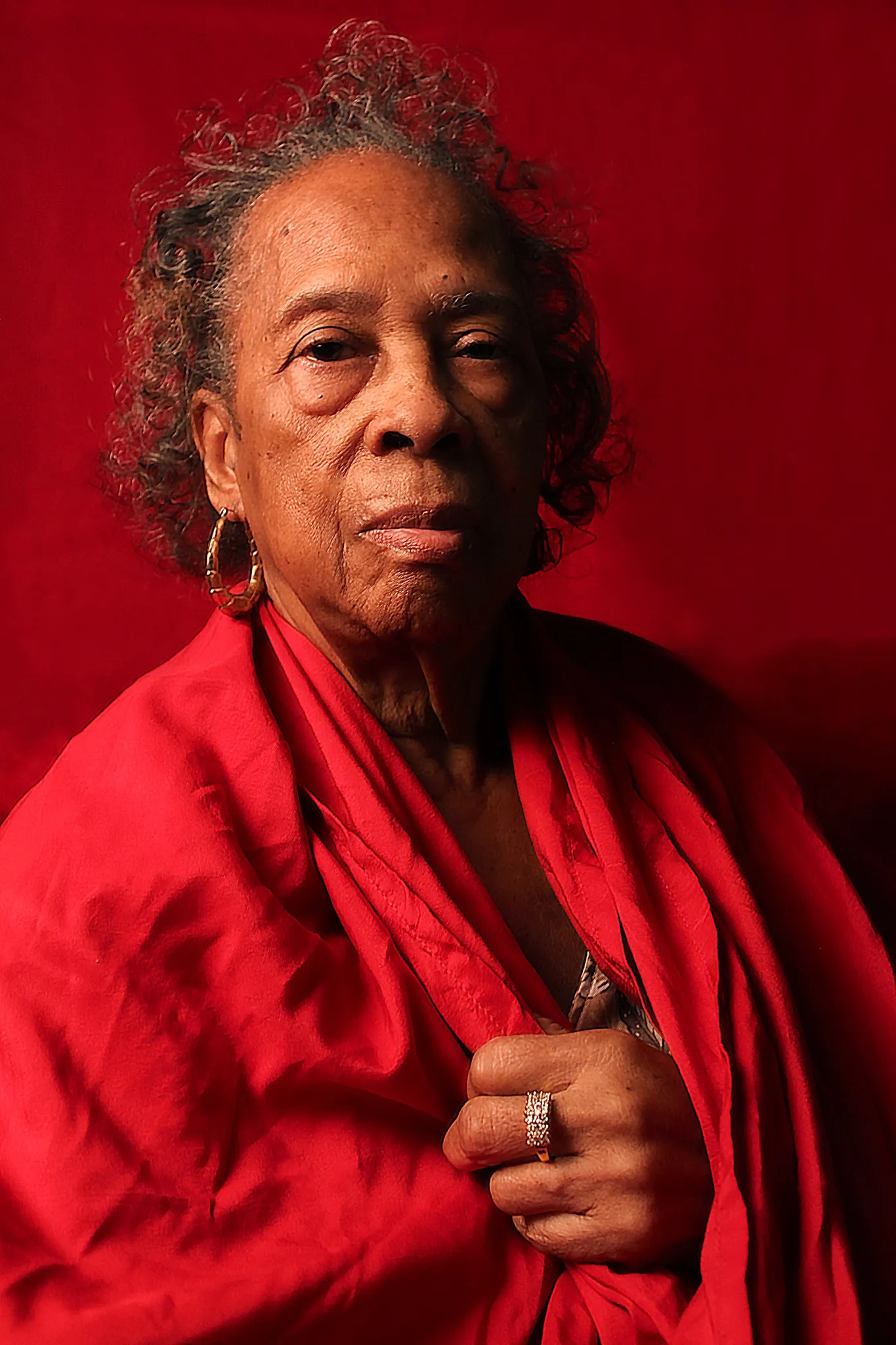
I photographed my grandmother (maternal) in 2019. This image is one of three from a series developed during my undergraduate thesis exhibition — a series in which her pose, the color red, and her gaze were each deliberate choices.
This photograph, for me, represents the many ways we perceive the matriarchs in our families. These women are often the ones who hold the family together, absorbing conflict and maintaining order. They are seen as pillars who are depended upon, yet the weight of that role is most often carried in silence.
When my grandmother passed not long after this photograph was taken, the thesis shifted. What began as an exploration of how we see these women became something more personal. It became an examination of loss and the particular emptiness left behind when the matriarch is gone.
I have borne witness to the gradual separation of what was once a close-knit family and the way things become increasingly obscured, questions go unanswered, and the person who once brought clarity is no longer there to hold it all together.
My grandmother migrated from South Carolina in the 50's to Miami before she started her family. She was a wife to an auto mechanic, a mother of five girls, and worked in housekeeping for decades. She was a woman who experienced life in the Jim Crow South. Even when she moved to a bigger city in search of opportunities, she was still constantly reminded of her skin color and gender. After she passed away, my mom rediscovered her ID card from the 1960s. This card represented the very thing required of people of color to access Miami Beach. Not to relax and enjoy the water, but solely to work. Years later, when I completed my thesis show, this photograph was regally hung in a glass window of an art institution in the same area of Miami Beach. This full-circle moment meant a lot to me, and I know it did for her as well.
When I look at this photograph, I can only imagine the many experiences my grandmother had throughout her life, the good and bad. Black women, and particularly our mothers and grandmothers, have long been cast as unbreakable and strong to their core. The " strong Black woman" trope, while it may have been created as a title to describe resilience amongst women, became a cage that many were trapped in. It gave everyone around them permission not to ask how they were doing, not to lighten the load, and never to truly see the cost. During the mid-1900s, emphasis was often placed on Black men in the family, as they were targeted by a biased system and faced dehumanization. While I agree that these issues are important, this focus inadvertently left many mothers and grandmothers overlooked in the narrative.
I want future visitors to understand the women who hold our families together, often the least held together themselves. The strength we celebrate in them was also a silence we benefited from. That appreciation shouldn't only be acknowledged after their passing. When this photograph is viewed, I want visitors to see a woman, not a pillar or a role. I want them to see a woman who gracefully carried years of quiet burdens without the opportunity to set them down. A woman whose humanity existed beyond what was provided for everyone.
This photograph is of my great-grandmother, Bettie "Mother" Jane, in the kitchen of the family home where generations of our family have gathered to celebrate holidays, birthdays, and special occasions. Although I don't know the exact date the photo was taken, it captures her in the place where she spent the majority of her life. She was known for her homemade biscuits and famous pound cakes, and family members always looked forward to anything she prepared because every meal reflected the love and care she put into it.
This image captures her in her natural element and reflects her stern nature when it came to anyone messing around in the kitchen. Now 97 years old, her light continues to shine and serves as a constant reminder to our family of the love, strength, and wisdom she has shared for generations.
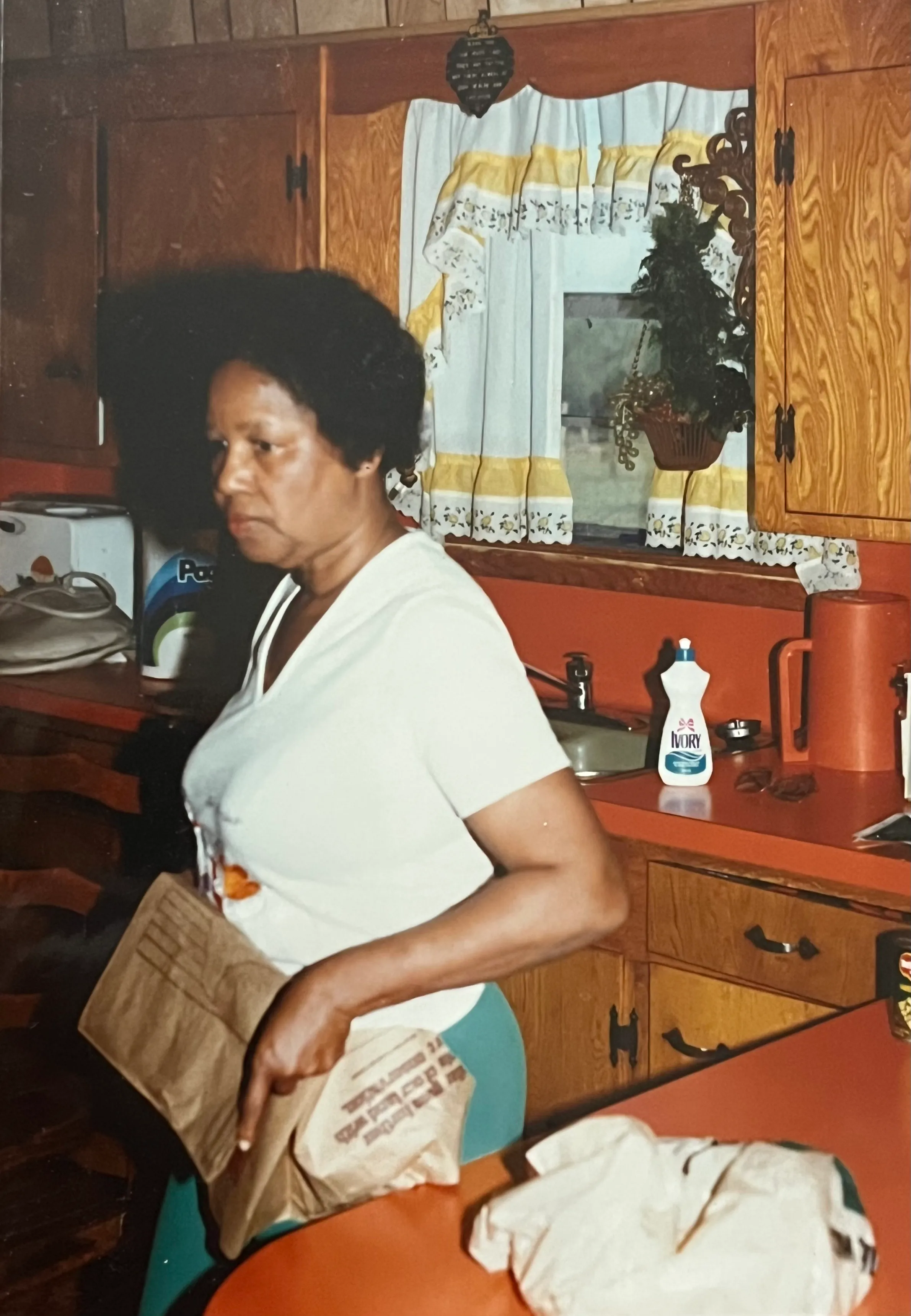
This photograph is of my great-grandmother, Bettie "Mother" Jane, in the kitchen of the family home where generations of our family have gathered to celebrate holidays, birthdays, and special occasions. Although I don't know the exact date the photo was taken, it captures her in the place where she spent the majority of her life. She was known for her homemade biscuits and famous pound cakes, and family members always looked forward to anything she prepared because every meal reflected the love and care she put into it.
This image captures her in her natural element and reflects her stern nature when it came to anyone messing around in the kitchen. Now 97 years old, her light continues to shine and serves as a constant reminder to our family of the love, strength, and wisdom she has shared for generations.
Coming from a small, religious country community, I feel like the smaller details of a person's life often fall through the cracks in favor of the bigger picture. While certain expectations of women and men are deeply rooted in my culture, it's easy for the person behind those roles to be overlooked. Many people know and love my great-grandmother, Bettie Jane, as the woman who raised a large family, devoted herself to her faith, and stood faithfully beside her late husband. While those roles are an important part of who she is, they don't tell her whole story.
This photograph reminds me of the woman behind the title of "Mother." She used to babysit me while I was growing up, and during those visits she would share stories about her childhood, her family, and what life was like when she was young. Having lived nearly a century, she has witnessed incredible changes, and I have always treasured listening to her experiences. Before becoming a stay-at-home mother, she worked as a seamstress and later as a teacher. She even made dresses for my grandmother and her sisters out of potato sacks, demonstrating her creativity and resourcefulness.
What I hope this photograph preserves is the part of Bettie Jane that could easily be forgotten: the woman with dreams, talents, and ambitions beyond the roles she fulfilled for others. Even today, I make it a point to call her at least once a month, not only because she is my great-grandmother, but because I want to continue learning from her while I still can. Her title will always be "Mother," but through this submission, I want to honor Bettie Jane.
This photograph connects to reparations, repair, accountability, and unresolved harm by highlighting how the lives of women like my great-grandmother are often left out of larger historical narratives in the United States. While her story is deeply personal and rooted in my family, it also reflects a broader pattern of how women’s labor, especially domestic work, caregiving, and sewing, has historically been undervalued or made invisible. Even though she helped sustain her family through both paid and unpaid work, those contributions are not the kinds of histories that are usually preserved or centered in official accounts. Instead, women like her are often remembered only through narrow roles such as “mother” or “wife,” which flattens the complexity of their lives.
Many women, especially in rural communities or working-class families, contributed significantly to their households and communities without receiving recognition or economic acknowledgment. What I want future visitors to understand is that this image is not just about one woman in a kitchen. It represents the broader need to acknowledge and repair historical erasure by recognizing the full humanity and labor of women like my great-grandmother. Her story matters not only within my family, but also within the larger story of the country, where so many similar lives have gone unseen or under-recorded.
The repair that is needed is a part of my maternal lineage for the first born daughter. We all have had to be responsible for things that were not ours to hold, forced to silence our grief, which has led to a cycle of painful mother/daughter relationships. The repair is simple -- giving Black women, girls, non-binary people the space to grieve, for comfort, for less responsibilities so the burdens of motherhood don't continue to tear us a part.
The repair that is needed is a part of my maternal lineage for the first born daughter. We all have had to be responsible for things that were not ours to hold, forced to silence our grief, which has led to a cycle of painful mother/daughter relationships. The repair is simple -- giving Black women, girls, non-binary people the space to grieve, for comfort, for less responsibilities so the burdens of motherhood don't continue to tear us a part.
The responsibility put on Black girls turns into the inability to be able to prioritize the many emotions we experience; it causes us to be stripped of our girlhood and, sometimes, of our ability to love our own daughters in ways that are healthy. This is by design; the Black enslaved woman was never seen as human, so that trauma shows up as a constant replication of dehumanization cloaked in responsibilities that are not ours and ours alone. Who is accountable for this? Colonizers. What can repair this? The humanity of Black women being reinstated, seen, and identified as a pathway to reparations.
That what I experienced is not mine alone. To look to the women in their family and chart their stories as far back as you can to see how, with each generation, girlhood is merely a word and not an invitation to be human.

My story is about my limited experience and multiple memories, but the two that started what it was like to have to define and defend my blackness in a world that had already been taught in community stereotype history systemic, perpetuation of slavery and family legacy. Being born by racial and what that meant of my blackness being illegal for a time and going back to field and how slaves and a lack of sisterhood and welcomeness into communities that created me not by choice, but was a product of two people who fell in love and had children, and then fell out of love and left their children in his space without a conversation of what their blackness would look like shaped how I have remembered growing up in my skin color and how much I am aware of the repair needed for myself, but in my community of what blackness is beyond this versus that and colorism of light skin versus dark skin.
My story is about my limited experience and multiple memories, but the two that started what it was like to have to define and defend my blackness in a world that had already been taught in community stereotype history systemic, perpetuation of slavery and family legacy. Being born by racial and what that meant of my blackness being illegal for a time and going back to field and how slaves and a lack of sisterhood and welcomeness into communities that created me not by choice, but was a product of two people who fell in love and had children, and then fell out of love and left their children in his space without a conversation of what their blackness would look like shaped how I have remembered growing up in my skin color and how much I am aware of the repair needed for myself, but in my community of what blackness is beyond this versus that and colorism of light skin versus dark skin.
It connects to repair accountability and unsolved harm in the United States because I can’t take off my skin color. I can’t change it and it’s a topic of conversation. It’s a topic of treatment. It’s a topic of my lived experience every day in the United States because of slavery, the direct impact. Of lack of accountability and the repair needed for the enslavement of people and the colorism attached to that the beauty standards that folks try to appropriate using my skin color that I can’t change and the harm done to so many people trying to change their skin and deform themselves or change themselves or do reparation from the third largest income streaming in the United States and a beauty standard that was designed to wash us and keep us out and is now set to profit, even more to slowly start to accept us, but only on a colorism scale.
I hope they understand that we can move past what is ingrained in a systemically and has a culture. We need to stop dividing ourselves in a category is a blackness, and I hope that it helps people who had this similar experiences. Me know they’re not alone know that you don’t have to explain what your blackness is. You don’t have to defend it. You don’t have to be ashamed of it. You don’t have to pick between two worlds. You didn’t betray one culture over another. You don’t have to pick one over the other you are black, beautiful, and a part of this culture just as much as anybody else.
In What We Carry, Dr. Ashley Gaddy Robbins traces how memory travels through families in spoken stories, silence, vigilance, and expectations of work and endurance. Drawing on her experience as the daughter of a formerly incarcerated parent, she considers how punishment extends into children’s lives through absence, stigma, and lost opportunity. Her reflection connects these inherited burdens to Black women’s everyday acts of resistance, including choosing rest, asking for help, and telling the truth. Within Room II, the recording asks what future generations could inherit if repair made room for belonging, possibility, and permission to put those burdens down.
In What We Carry, Dr. Ashley Gaddy Robbins traces how memory travels through families in spoken stories, silence, vigilance, and expectations of work and endurance. Drawing on her experience as the daughter of a formerly incarcerated parent, she considers how punishment extends into children’s lives through absence, stigma, and lost opportunity. Her reflection connects these inherited burdens to Black women’s everyday acts of resistance, including choosing rest, asking for help, and telling the truth. Within Room II, the recording asks what future generations could inherit if repair made room for belonging, possibility, and permission to put those burdens down.